
|
News Detail
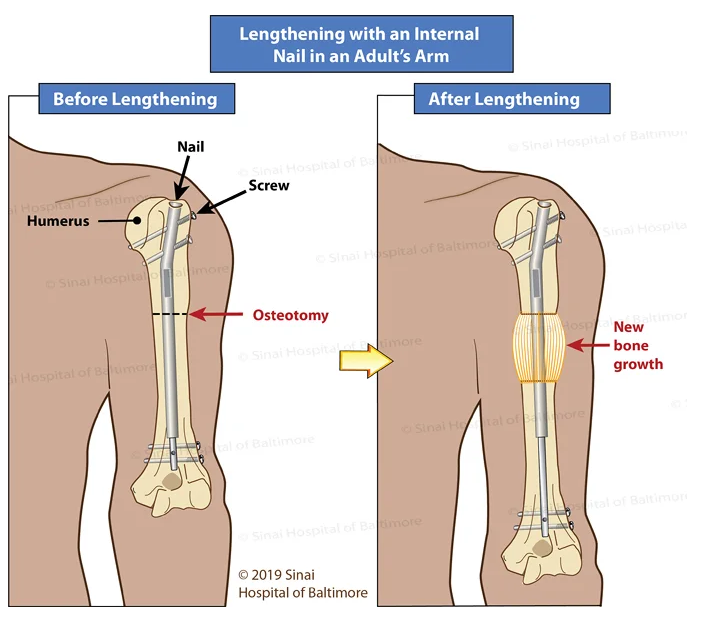
Internal Fixation: Precice Nail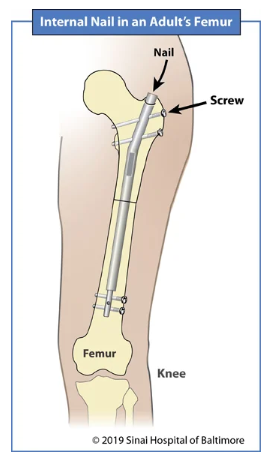 What is internal limb lengthening?Internal limb lengthening is when the device used to lengthen the bone is inserted inside the bone. The lengthening device has a small magnetic motor inside it. When the motor is activated by an External Remote Controller (ERC), the device slowly lengthens, and this causes the bone to slowly lengthen. Previously, the only way to lengthen a bone was to apply a metal scaffolding to the leg called an external fixator. External fixators are metal devices that are attached to the bones with special threaded pins or wires. These threaded pins or wires pass through the skin and muscles and are inserted into the bone. The majority of the lengthening device is outside of the body. Please visit Limb Lengthening: The Process for general information about limb lengthening. What is the Precice and how does it work?
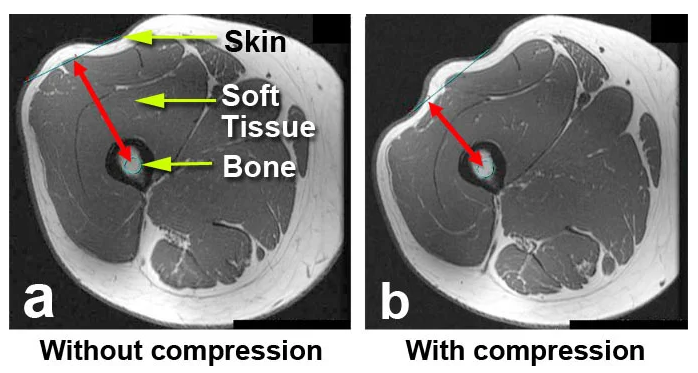
The Precice Lengthening System (NuVasive Specialized Orthopedics, San Diego, CA) consists of a telescoping metal rod, called a lengthening nail, with a magnetic motor inside of it. The nail is inserted through a small incision into the bone canal where the bone marrow is found. The patient is given a special device called an External Remote Controller (ERC) that is used to make the Precice nail slowly lengthen. The ERC has a magnet inside it that rotates. When the ERC is placed against the leg or arm and turned on, the movement of the magnet inside the ERC causes the magnetic motor inside the Precice to slowly lengthen. When the Precice lengthens, the bone also lengthens. Will Precice lengthening hurt?Precice lengthening with the ERC is so gradual that nearly all of our patients have told us that their leg does not hurt during the lengthening sessions. What is our center’s experience with the Precice?The original physician development team for the Precice nail consisted of Dr. Shawn Standard and Dr. John Herzenberg, both from the International Center for Limb Lengthening, and Dr. Stuart Green. These doctors worked with a company to produce this revolutionary new internal lengthening nail. Our doctors have been using the Precice system since 2012. The first model that was released was a modular design that was composed of two sections assembled at the time of surgery. The newer model is a single piece, which makes the nail much stronger. We have found the Precice to be very effective in helping our patients. In the first 100 bones that we treated, 96% achieved the lengthening goal. In another study that we conducted, patients had lengthening with external fixation and then later had lengthening with the Precice. All the patients in the study preferred lengthening with the Precice over external fixation. They said that they had less pain, found physical therapy to be easier and liked the cosmetic appearance of the leg/arm better after treatment with Precice. Since 2012, surgeons at the International Center for Limb Lengthening have implanted more than 710 Precice nails. Will the Precice be a good option for every person who needs limb lengthening?The Precice nail is offered in several lengths and diameters, but a person’s bone may still be too small for it. The diameter of the bone must be wide enough so that the Precice can fit inside the bone canal. The doctor will measure the diameter of the bone on an X-ray. The Precice is offered in three diameters: 8.5, 10.7 and 12.5 mm (0.33, 0.42, 0.50 inches). The bone also needs to be long enough to fit the Precice. The shortest nail is 6.3 inches (160 mm) for the tibia and 6.7 inches (170 mm) for the femur. The doctor will measure the length of the bone on an X-ray to see if it is long enough to accommodate the Precice nail. Another factor that must be considered is whether the ERC can be placed close enough to the Precice to make it lengthen. Soft-tissues (muscle, fat, skin) can be so thick that the ERC cannot be placed close enough to the Precice to activate lengthening. To see if the Precice will work for a patient, the doctor will measure the distance from the bone canal to the skin on an X-ray. People are not good candidates for the Precice if they have a pacemaker or know that they will need an MRI scan in the next year. It is generally not recommended to have an MRI scan when a person has a Precice nail implanted. Therefore, we routinely recommend removal of the Precice about one year after surgery, provided that the lengthened bone is fully healed. Can the Precice internal nail be used in children?A Precice nail may be inserted in a child’s thigh bone (femur) starting at about age eight years. For the shin bone (tibia), it is preferable to wait until close to skeletal maturity (age 14 years in girls and age 16 years in boys). How much will the Precice lengthen a bone?The bone is lengthened in very small amounts each day until the lengthening goal is achieved. The maximum amount that can be lengthened depends on which model of the Precice is used. Different Precice models can lengthen the bone a total of 1.2 inches (30 mm), 2 inches (50 mm) or 3 inches (80 mm). For example, if the shortest Precice is the only one that fits in the bone, the patient may be limited to lengthening a total of 1.2 inches. In most cases, we can implant the models that allow 2 to 3 inches of length. To help you prepare for limb lengthening surgery success, we have developed this brochure of prehabilitation stretches to perform in the months prior to surgery. This is not medical advice; please consult with your doctor before beginning any exercise regime. What should be done to prepare for surgery?Please visit our Before Surgery section for detailed information. During the visit with the doctor, ask for our guide to prepare for surgery. When planning for Precice surgery, you should also be aware of the following:
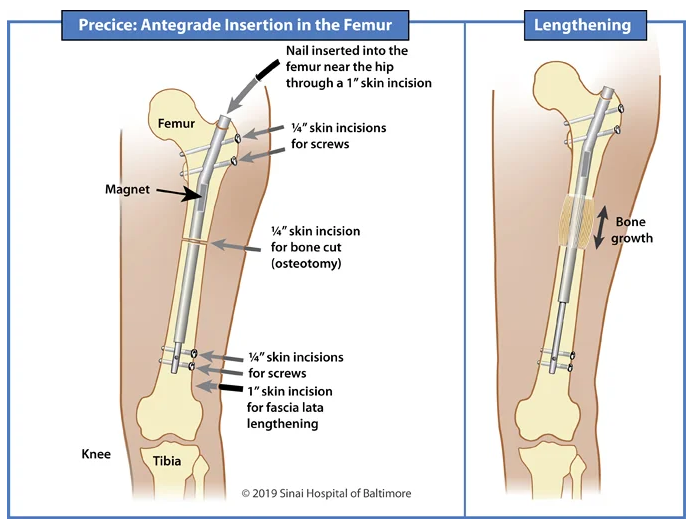
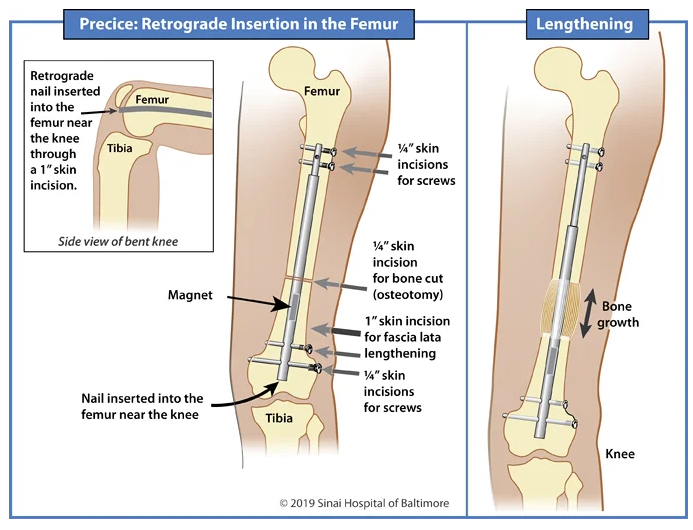
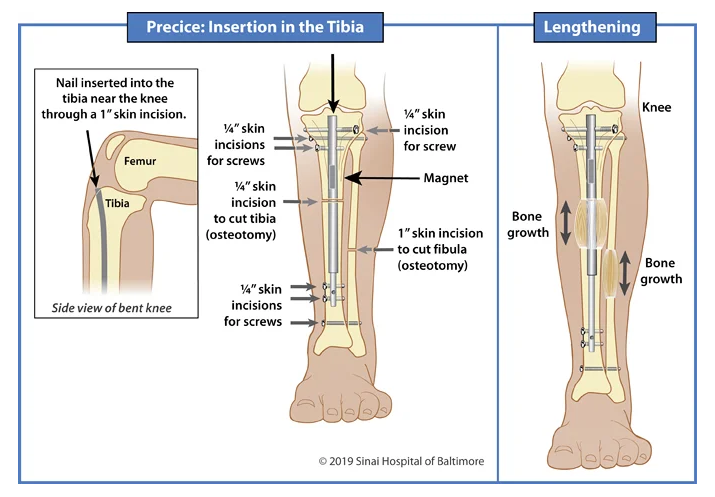
How is the Precice inserted during surgery?The doctor needs to make space for the device to fit inside the bone. The outer part of a bone is made up of hard tissue, but the inside of a bone is made up softer marrow tissue. The doctor will use an orthopedic drill to create a canal in the marrow cavity in the center of the bone. This canal will be large enough for the Precice to fit inside it. The way the Precice is inserted depends on the bone and the patient’s unique situation:
|
 |
Shanghai Carefix Medical Instrument Co., Ltd.China
滬ICP備16042301號-1 (滬)-非經(jīng)營性-2016-0122 滬食藥監(jiān)械生產(chǎn)許20101725號
